Kaizen session

CLEAR
WRITING

If it is fuzzy on the page, it is fuzzy in your head.

30 minutes on memos, mails, briefs and slide titles
A tangled line resolving into a straight line ending at a pen nib
01 / 18

Read this

An update that arrived last week

76 words "Further to the discussions held during the review meeting last week, and taking into account the various inputs shared by the team, we have been working on evaluating multiple options with respect to the ongoing digital campaign, and it was felt that there may be a need to relook at certain aspects of the current approach in order to ensure better alignment with the overall objectives going forward. Your thoughts on the same would be appreciated."

Three questions it does not answer

What was found? What is being proposed? What do you want me to do, and by when?

The writer spent twenty minutes on this. Every reader spends two minutes decoding it and still has to ask.

02 / 18

The premise

Amazon banned PowerPoint in 2004

"The narrative structure of a good memo forces better thought and better understanding of what's more important than what."

— Jeff Bezos, 2017 shareholder letter

A bullet lets you assert something. A sentence makes you connect it to the point before it. Gaps in reasoning survive bullets and do not survive paragraphs.

03 / 18

The cost

What unclear writing costs us

Rework

A vague brief goes to the agency. Creative comes back wrong. Two weeks gone, budget spent.

Delay

A mail with no ask sits for four days while three people work out who is meant to act.

Drift

"Improve distributor experience" means five different things to the five people who read it.

Dilution

The one finding that mattered is on slide 14 of 30, under the heading "Other Observations".

Writing is the cheapest test of whether you have an idea. It costs an hour and it exposes the parts you have not worked out yet.

A magnifying lens resolving blurred lines of text into crisp lines
04 / 18

The diagnosis

Five faults. They account for almost everything.

FAULT 01

The answer is buried

The point arrives in the last line, if at all.

FAULT 02

Abstraction

Words that could describe any company in the industry.

FAULT 03

Nobody does anything

Passive verbs and hidden nouns remove the actor.

FAULT 04

Clutter

Sixty words carrying eighteen words of meaning.

FAULT 05

No ask

The reader finishes and does not know what to do.

Each one is fixable in a single editing pass. None of them requires talent.

05 / 18

Fault 01

The answer is buried

Lead with the finding. Then explain how you got there.

Buried "As discussed in Thursday's review, and following the analysis the team has run over the past two weeks on the SIP book, we have looked at several cuts of the data and wanted to share some observations for your consideration."
Answer first "SIP net flows fell 12% in Q1. One distributor group explains 60% of the drop. Ask: approve a ₹40 lakh retention spend on that group by Friday."
Subject line "Campaign update"
Subject line "Digital CAC down to ₹710 — requesting ₹2 Cr shift to IFA enablement"
Covering note "Please find attached the deck for your kind perusal and revert with your valuable feedback."
Covering note "The attached deck recommends dropping two of the five creative routes. Slide 3 has the reasoning."

Test: if the reader stops after the first line, do they still know the point? Most of them will stop after the first line.

06 / 18

Fault 02

Abstraction instead of specifics

Every claim carries a number, a name, or a date. A claim without one of those is an opinion.

Vague "Engagement on the campaign was encouraging across channels."
Specific "18,400 clicks and 620 new SIP registrations at ₹710 per registration, against a ₹1,150 target."
Vague "We are exploring various options to improve the distributor experience."
Specific "We are testing two things with 40 IFAs in Pune: a WhatsApp fund-fact bot, and same-day commission statements."
Vague "The response to the new fund offer has been fairly good."
Specific "The NFO collected ₹310 Cr against a ₹250 Cr target. 71% came from first-time investors."

Test: could this sentence be true for any AMC in the country? If yes, it tells your reader nothing about ours.

07 / 18

Fault 03

Nobody does anything

Passive verbs and hidden nouns are how accountability disappears from a sentence.

No actor "Implementation of the revised process will be undertaken by the operations team in due course."
Named actor "Ops runs the new process from 1 August."
No actor "A decision on the creative was taken during the review."
Named actor "The brand committee approved route B."
No actor "There is a requirement for clarification on the risk disclaimer."
Named actor "Compliance wants the risk disclaimer rewritten by Tuesday."

Two tests. For the passive, add "by the ops team" to the end of the sentence. If it still reads, the verb is passive. For the hidden noun, look for implementation, clarification, utilisation, alignment. Each one has a verb trapped inside it.

08 / 18

Fault 04

Clutter

Sixty words carrying eighteen words of meaning. The reader pays for all sixty.

at this point in timenow
in order toto
due to the fact thatbecause
in the event thatif
has the ability tocan
prior tobefore
it is important to note thatdelete it
going forwarddelete it
Before — 60 words "It is important to note that, at this point in time, we are in the process of undertaking a review of the current media plan in order to determine whether there may be an opportunity to reallocate a certain portion of the budget with a view to improving overall efficiency, and we will revert with our recommendations in due course."
After — 18 words "We are reviewing the media plan for budget we can move to better-performing channels. Recommendations by 8 August."

The short version also says more

It names a date. The sixty-word version avoided one.

09 / 18

Fault 05

No ask

The reader finishes, agrees with you, and does nothing, because you never said what you wanted.

No ask "Let me know your thoughts on the same."
Clear ask "Need a yes or no on the ₹40 lakh by Thursday 5 p.m. If I do not hear back, we hold the spend."
No ask "Requesting you to kindly do the needful at the earliest."
Clear ask "Please approve invoice #4412 in SAP by 31 July so the agency is paid this cycle."
No ask "We may want to consider revisiting the media mix at some stage."
Clear ask "I recommend moving ₹2 Cr from display to IFA enablement. Sign-off needed from you and Finance before 5 August."

Four things in every ask: the person, the action, the date, and what happens by default if nobody replies.

10 / 18

Structure

Answer first, then the reasons, then the evidence

  • 01One sentence at the top: the finding or the recommendation.
  • 02Three supports beneath it, each carrying a number.
  • 03Evidence under each support, for the reader who wants to check.

Written this way, the memo survives being read out of order, which is how it will be read. Detective novels put the answer last. Business writing runs the other way.

— Barbara Minto, The Pyramid Principle (McKinsey, 1973)

THE ANSWER One sentence SUPPORT 1 with a number SUPPORT 2 with a number SUPPORT 3 with a number Evidence, for the reader who wants to check
11 / 18

Structure in practice

The same note, twice

Situation, complication, question, answer. Four lines, in that order.

How it usually arrives "Hi team — as you know, the digital campaign has been running since April. There have been some learnings. The agency has shared a detailed report. We had a discussion with the media team and there are a few areas where we could look at improving. Detailed deck is attached. Requesting your inputs on the same."
Situation → complication → question → answer

S — The digital campaign has run since April on a ₹6 Cr budget.

C — Display is costing ₹1,940 per SIP registration against a ₹1,150 target. IFA enablement is costing ₹710.

Q — Do we keep funding display for the rest of the year?

A — No. Move ₹2 Cr from display to IFA enablement from 1 August. Decision needed by 5 August. Numbers are on slide 3.

The second version is shorter, and it is the only one the reader can disagree with. A vague note removes the reader's ability to push back, which is usually why it was written that way.

12 / 18

The biggest single fix

Slide titles carry the claim

A label tells the reader what the slide is about. A claim tells them what you found.

"Q1 Performance" "Q1 flows fell 12%; one distributor group explains 60% of it"
"Digital Marketing Update" "Cost per SIP registration fell to ₹710, below the ₹1,150 target"
"Way Forward" "Move ₹2 Cr from display to IFA enablement in Q3"
"Key Challenges" "Three things will stall this: approval time, creative supply, IFA coverage"
"Competitor Analysis" "ICICI outspends us 2:1 on digital and wins on SIP count, not ticket size"
"Recommendations" "Fund two of the five creative routes; drop the other three"

Read only your titles, top to bottom. If they do not tell the whole story on their own, the deck depends on you being in the room. Most of the time you will not be.

13 / 18

The format

The one-page memo

For anything that needs a decision. Six blocks, one page, no attachments required to understand it.

BLOCK 01

The claim

One sentence. The finding or the recommendation.

BLOCK 02

Why it holds

Three supports. Each one carries a number.

BLOCK 03

What it costs

Money, people, time. Each one written down.

BLOCK 04

The case against

The strongest argument against your own recommendation, put fairly.

BLOCK 05

The ask

Person, action, date.

BLOCK 06

The default

What happens if nobody replies by that date.

Block 04 is the one people skip. Putting the counter-argument in your own memo is what makes the other five blocks credible.

14 / 18

Writing with AI

The AI draft has no numbers, no claim and no ask

Same brief: "Write an update on the digital campaign for the CMO."

Raw AI draft "Our digital campaign has delivered encouraging results across multiple channels this quarter. The team has worked to optimise performance and we continue to see meaningful engagement. Going forward, we will focus on driving greater efficiency and unlocking further value from our media investments."
After editing "Display is costing ₹1,940 per SIP registration against a ₹1,150 target. IFA enablement is costing ₹710. Recommend moving ₹2 Cr from display to IFA enablement from 1 August."
Words
Numbers
Claims
Asks
Raw AI draft
43
0
0
0
After editing
28
5
1
1

The model writes grammatical sentences at speed. It has no access to your numbers and no stake in the decision, so it fills the space with words that describe activity instead of results.

15 / 18

Writing with AI

Three tells to strip out

Senior readers spot these in a line and discount everything after them.

Tell 1 — the flip "Investor count is not the problem. Value per investor is."
Say it once "FY27 marketing should concentrate on value per investor."
Tell 2 — the ladder "Not just a campaign — a movement."
Say what it is "A campaign running July to September across 40 IFA offices."
Tell 3 — intensifiers "A truly powerful, best-in-class distributor experience."
Name the thing "Same-day commission statements and a 24-hour query response."

Delete on sight

unlock · supercharge · transform · leverage · robust · world-class · seamless · holistic · cutting-edge · going forward · at the end of the day

16 / 18

Writing with AI

Give it the structure. Keep the judgement.

Hand to the model

First drafts against a structure you supply · turning a rough note into the memo format · finding the counter-argument you missed · tightening a paragraph you already wrote · summarising twelve pages you will not read

Keep for yourself

The claim · the numbers · the ask · anything that commits the team to spending money or making a promise to a distributor or an investor

Editing a weak draft is faster than starting from a blank page. Signing off on one you did not check is how a wrong number reaches the CMO with your name on it.
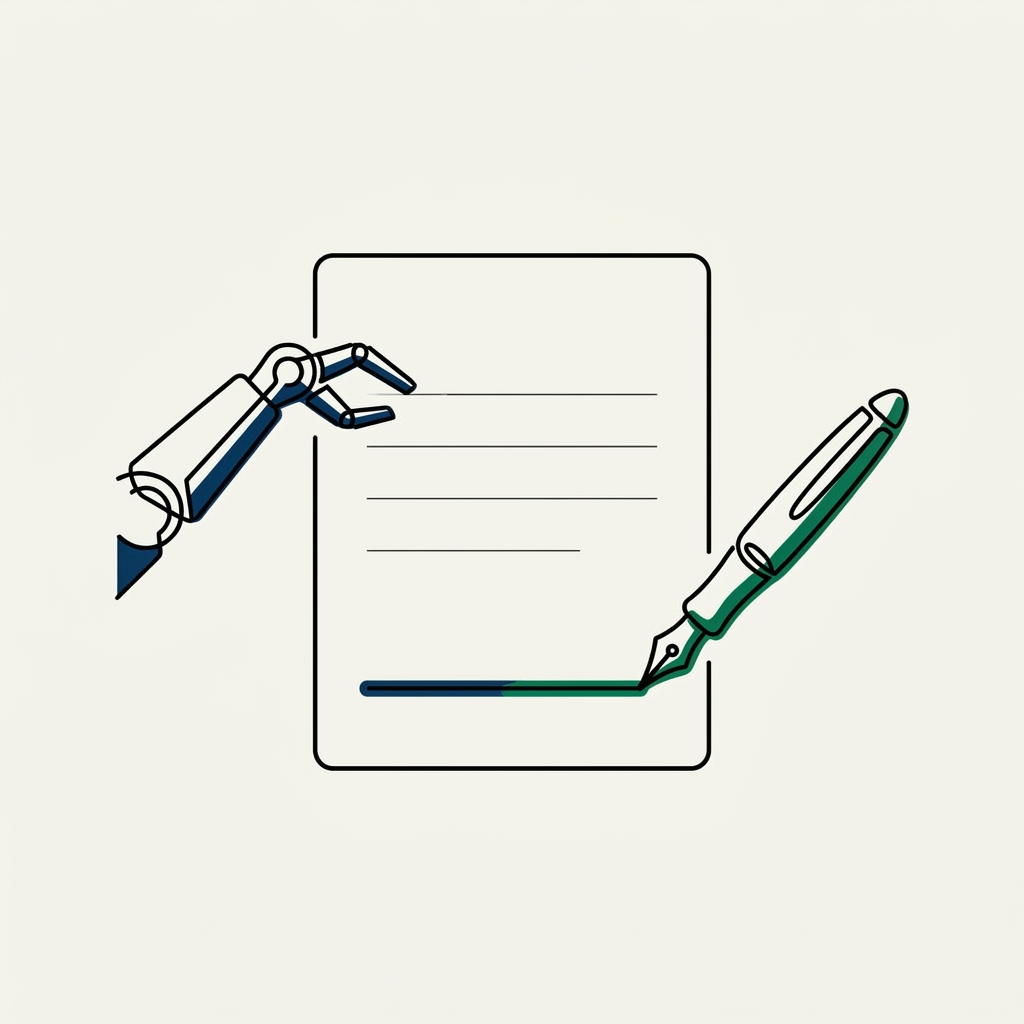

A mechanical arm sketching the first lines of a page while a human hand writes the last one
17 / 18
A pen nib with a single clean line flowing into an arrow

Write it down.
That is when you find out whether you have an idea.

Answer first. A number on every claim. A person and a date on every ask.

18 / 18